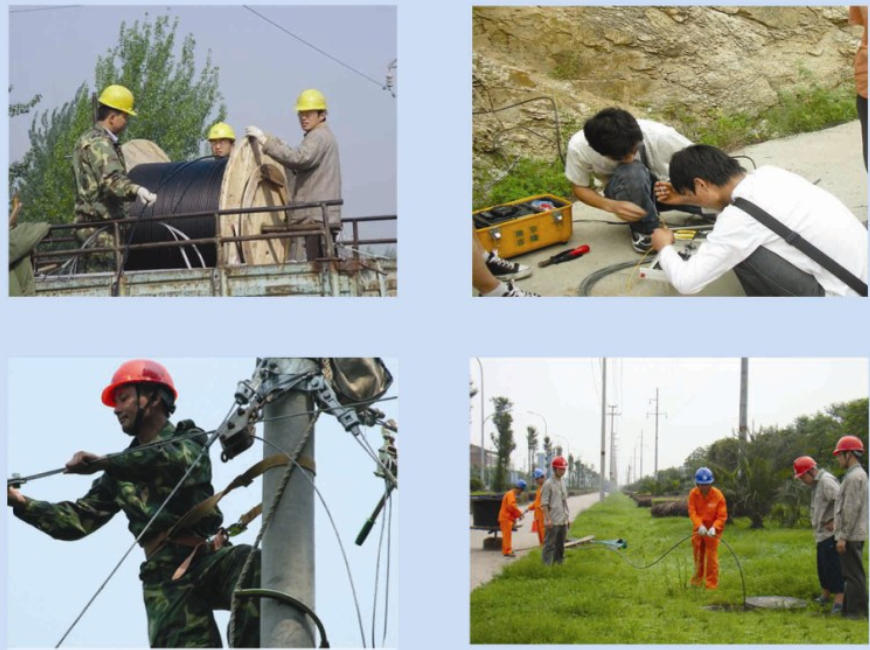
🔥 The Make-or-Break Moment for Any Optical Cable: INSTALLATION.
A top-tier GYTS cable can still fail if installed poorly. They say it’s “30% product, 70% installation”—here’s how to get that 70% right.
🧱 3 Main Installation Methods & What Matters
| Method | Best For | Key Requirements |
| Duct Installation | Urban underground, tunnels | Clean ducts before pulling. Tension ≤ 1500N. Leave slack in manholes. Use cable markers. |
| Direct Burial | Rural areas, no duct infrastructure | Burial depth: ≥0.8m under roads, ≥0.6m elsewhere. Use flat trench, compact backfill, and warning tape/bricks. |
| Aerial Installation | Existing or new utility poles | Support with messenger wire (max 50m spans). Ensure pole strength, sag control, and safe distance from power lines. |
⚡️ The 3 Non-Negotiable Rules of Installation
No matter the method, these rules are absolute:
➡️ Respect the Bend Radius
Static (after install): ≥ 10x cable diameter.
Dynamic (during install): ≥ 20x cable diameter.
A sharp bend = increased attenuation or broken fibers.
➡️ Never Exceed the Pulling Tension
Pull force must be applied to the central strength member, NEVER the outer sheath or fibers.
Max instantaneous pull force ≤ 100% of cable’s short-term tensile rating (3000N for standard GYTS).
➡️ Splice with Precision
Splices must be inside an IP68-rated closure, sealed with gel and moisture-absorbent packets.
Average splice loss should be < 0.08dB per joint.
🎯 Good installation isn’t just following steps—it’s understanding the why behind every tension limit, every bend radius, and every seal.
Whether you’re an engineer, a project manager, or a technician, respecting the craft of installation ensures the network performs as designed—for decades.
👇 Have you seen a project fail (or succeed) because of installation quality? Share your story below.